

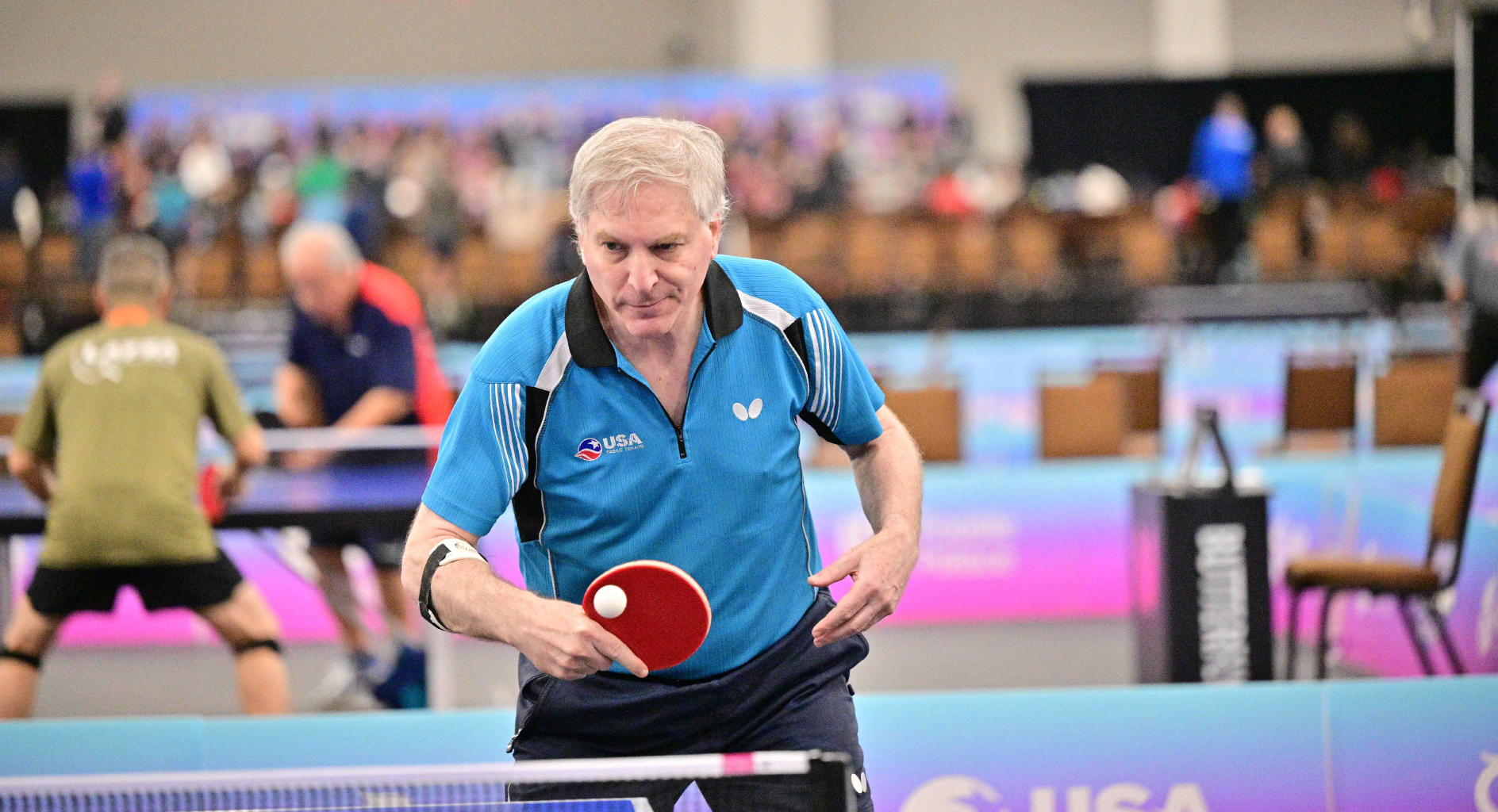
(By Larry Hodges, Member of US Table Tennis Hall of Fame
Most often coaches and top players (including me) talk about attacking the “three spots” – wide forehand and backhand, and middle (opponent’s transition point between forehand and backhand, roughly the elbow). But there are really five spots to play, though not always in the same match. Do you play all five? Which spots you play should change from match to match, depending on the opponent. And note the obvious parallels between the first two and the last two – for #1 and #5, and #2 and #3, I’ve just flipped the words “forehand” and “Backhand.” (For the following, unless otherwise noted, we’ll assume both players are righties; lefties adjust. Sorry!)
1. Wide forehand. When your opponent plays to your forehand, then you have an angle into their wide forehand where you can often attack outside the forehand corner. If the opponent isn’t ready for it, that’s the spot to attack, as wide as possible. In fact, think of this as playing the “wide, wide forehand.”
2. Forehand corner. From your forehand side, the opposite corner gives you the most table, diagonally to their forehand corner. This is where play both for safety and for strong attacks where you might need more table. It’s also where you play when playing a backhand down the line to the forehand. It’s especially effective if your opponent is looking to cover the wide angle you have into his backhand, or if he has a weaker forehand. (For down-the-line shots, it’s often good to set up as if you are going crosscourt, then go down the line.)
3. Middle. This is the opponent’s transition spot between forehand and backhand. It’s usually around the elbow, but it’s different for different players. Against a strong forehand player, it might be more toward the backhand side, and vice versa for a strong backhand player. Whenever possible, attack this spot relentlessly until you get the right ball to put away to a wide corner or middle again. Against attacks to their middle, opponents will often be a bit slower to react as they have to decide between forehand and backhand, and they have to move into position. So they’ll make more outright mistakes or weaker shots. It also takes them out of position, leaving a wide corner open. (Sometimes they’ll rush to cover the open corner, so instead go to the other corner.)
4. Backhand corner. From your backhand side, the opposite corner gives you the most table, diagonally to their backhand corner. This is where play both for safety and for strong attacks where you might need more table. It’s also where you play when playing a forehand down the line to the backhand. It’s especially effective if your opponent is looking to cover the wide angle you have into his forehand, or if he has a weaker backhand. (For down-the-line shots, it’s often good to set up as if you are going crosscourt, then go down the line.)
5. Wide backhand. When your opponent plays to your backhand, then you have an angle into their wide backhand where you can often attack outside the backhand corner. If the opponent isn’t ready for it, that’s the spot to attack, as wide as possible. In fact, think of this as playing the “wide, wide backhand.”
Stay “In The Loop” with Butterfly professional table tennis equipment, table tennis news, table tennis technology, tournament results, and We Are Butterfly players, coaches, clubs and more


 /* Constant Contact Universal Code */