
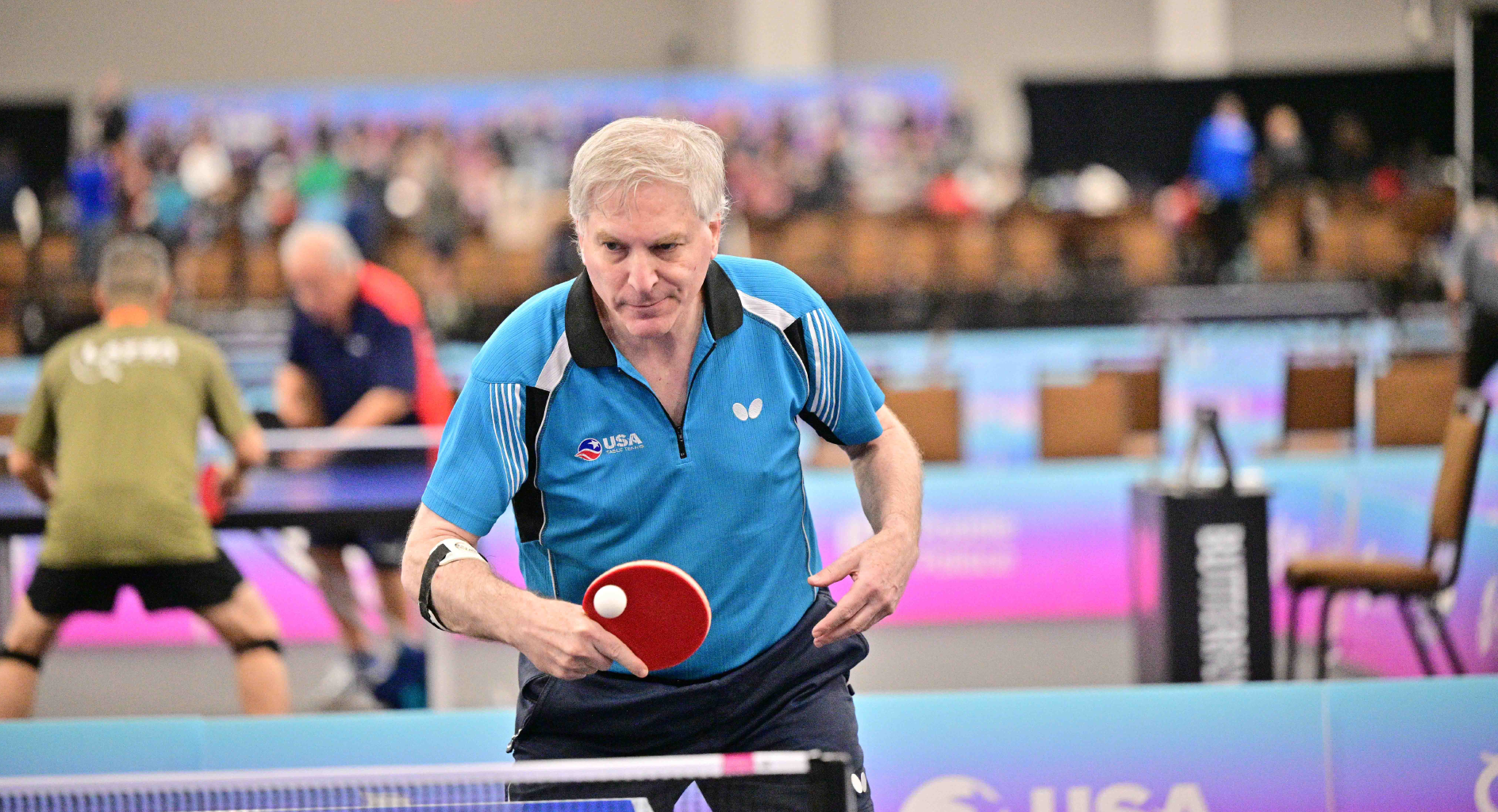
(By Larry Hodges, Member of US Table Tennis Hall of Fame, www.tabletenniscoaching.com/blog)
Where to position yourself on the receive is one of those things that has evolved over the years, especially with the advent of the banana backhand flip. There was a time when many top players favored forehand receives, even against short serves. (I was one.) But now many players are better receiving backhand against short serves, but forehand against longer serves. What should you do? Well . . . it depends on your own receive strengths and weaknesses. There are four main cases.
1) You could just receive where the ball is served, forehand or backhand. If you are weaker on some of these receives on one wing, then by doing it regularly it’ll get better. This is the simplest way to deal with this. But it’s not for everyone.
2) If you are stronger on the backhand against most serves, short or long, then you should of course favor that. Other than perhaps a deep serve to the wide forehand, you can receive almost everything with the backhand if you choose. In this case, you might position yourself well toward your forehand side, and unleash heck on your opponent with your backhand.
3)The same is true if you are stronger on the forehand against most serves, short or long (as I used to be). In this case, you stand as far to your backhand side as you can and are still able to cover any deep serves to your forehand. Some players do not have a good, fast, down-the-line serve (assuming they are serving from their backhand side, as most do), and if they don’t, you can favor the forehand receive even more. Against a player like this, I used to sometimes practically stand outside my backhand corner!
4) The final case is if you favor your backhand against short serves, but your forehand against deep serves. (I’ve evolved to that state.) This is true of most top players. So, what should you do? First, of course, many top players simply train hard to develop their backhand loop receive so they can use it against both short and long serves effectively. This allows them to really cover the table with their backhand receive, knowing that at the higher levels, they’ll get more short serves than long ones. (They’ll also get a lot of “half-long” serves, where the second bounce would be at or just off the end-line – but you can loop these serves, so for our purposes treat them as long serves. Note that even if the second bounce is right at the end-line, that’s long enough to loop – you simply go slightly over the table.)
But if you prefer receiving with the backhand against short serves, and the forehand against deep serves, then what? If you stand more in a backhand position, you’ll be fine against short serves, but you’ll be stuck with your backhand against deep serves unless you have super-human speed and reactions. Instead, it’s perhaps better in this case to favor the forehand, and look to cover as much of the table as you can against deeps serves with the forehand. When you get a short serve, you simply step over and receive backhand. It’s as simple as that. Short serves cannot come at you fast, so you have more time than against an aggressive deep serve. There are highly athletic players who are literally able to forehand loop against a deep serve to the backhand, and backhand flip against a short serve to the forehand.
HOWEVER . . . having said all that, it’s probably best to simply vary your receive positioning, based on the server, and sometimes vary it even as he’s serving, so he doesn’t know what side you are favoring. Trying to cover the whole table with your forehand against deep serves and the whole table with your backhand against short serves is exceedingly difficult and not really recommended. But if you vary your receiving position, both at the start and as the server is serving, then he’ll never know what to do, and you’ll more likely get to receive the way you want to. Personally, I find that even at age 65, I can pretty much cover the entire table with my forehand against deep serves (except sometimes against fast serves to the very wide backhand), while still covering 3/4 of the table with my backhand against short serves, receiving forehand only against short ones to the wide forehand. Or I can cover the entire table with my backhand against short serves, and 3/4 of the table with my forehand against deep serves, receiving backhand there only against deep serves to the wide backhand.
Note the one option I didn’t cover – those who favor receiving short serves with the forehand, and deep serves with the backhand. If this is true for you, then you are a Martian or something as I’ve ever seen anyone who does this!
Stay “In The Loop” with Butterfly professional table tennis equipment, table tennis news, table tennis technology, tournament results, and We Are Butterfly players, coaches, clubs and more