
(by Steve Hopkins, photo ITTF)
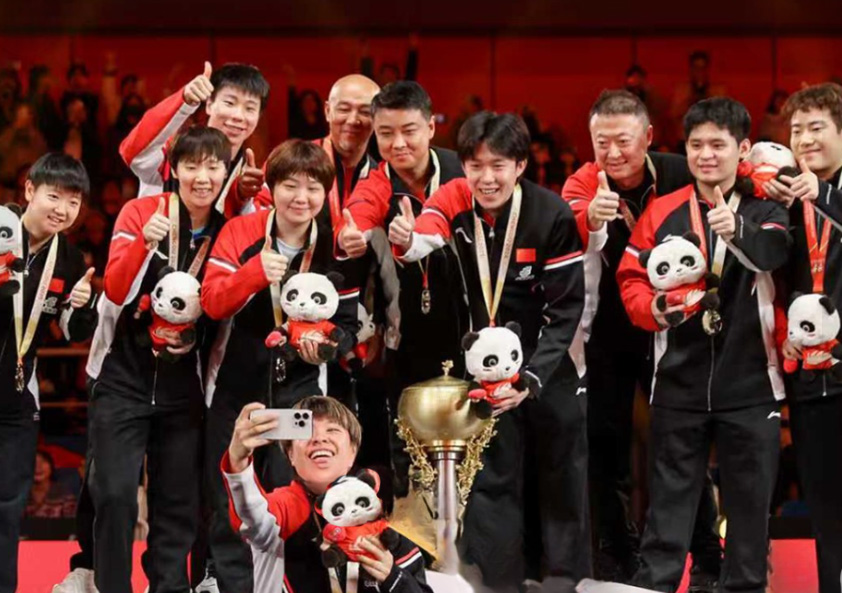
Tomokazu Harimoto won the first game against Lin Shidong, but with Japan already down 0-6 the result was all but a foregone conclusion. Shidong dominated the next two games and China claims Gold with an 8-1 score at this rendition of the ITTF Mixed Team World Cup. The two 3-0 wins for China were Wang Chuqin and Sun Yingsha (both World No. 1) over Matsushima and Odo in Mixed Doubles and Wang Manyu (World No. 2) over Miwa Harimoto.
There are no surprises in a team event where one squad has World No. 1 and 2 in both male and female singles categories. China has had absolute dominance across much of our sport, and a team format makes upsets even more unlikely – as its likely three separate upsets would need to occur in one team match for China to fall. Still, this format will be in play at the next Olympics, and the rest of the world has a few months to make adjustments.
For their part, Japan has clearly emerged as the second best team in the world. Tomokazu Harimoto was the highest ranked non-Chinese male present and the recent rise of Sora Matsushima (World No. 8) provides Japan with a second strong male player. Japan’s women are extremely strong and deep (against the non-Chinese table tennis world) with Miwa Harimoto at World No. 6, Mima Ito at World No. 8, and Satsuki Odo at World No. 14. In the Semifinals today, second-seeded Japan faced off against the third ranked team, Germany. The Japanese mixed doubles team of Ito and Shinozuka won easily (3-0) over Kaufmann and Franziska. Miwa Harimoto then edged out Sabine Winter 2-1 to give Japan a 5-1 lead. Dang Qiu then won the only match for Germany, taking 2 of 3 over Sora Matsushima. And then Japan closed the door with Matsushima and Togami topping Duda and Qiu. Japan had an early lead that was never truly challenged. And, Tomokazu didn’t play – that is, the top male player for Japan was able to rest for the Final.
Looking forward towards the Olympics, expect that China and Japan will be ready – both with strong contingents in both male and female singles and a history of strong doubles play (for an event where there are potentially three doubles sets and only two singles sets per team match). Its the other teams that will make things interesting. Can Germany improve its female singles play and its doubles? Can Korea’s strong doubles play be matched with a few key upsets. Sweden (who played without Truls Moregard) plays strong doubles and has had big singles upsets – but can their ladies hold their own at this level? If the French men continue to improve, they could have the strongest non-Chinese men’s team coupled with the Lebrun brothers as an experienced doubles team but they need to giant step on the women’s side. And interestingly, Romania may have all the firepower they need on the women’s side – but will their fast improving young male players improve quickly enough?
This is an interesting twist on our sport, and while there are some clear advantages to teams with great players (like China, obviously), the focus on doubles could provide some interesting plot twists in 2028 when Los Angeles hosts the next Olympics.
Visit ButterflyOnline.com for the latest table tennis news and results.