

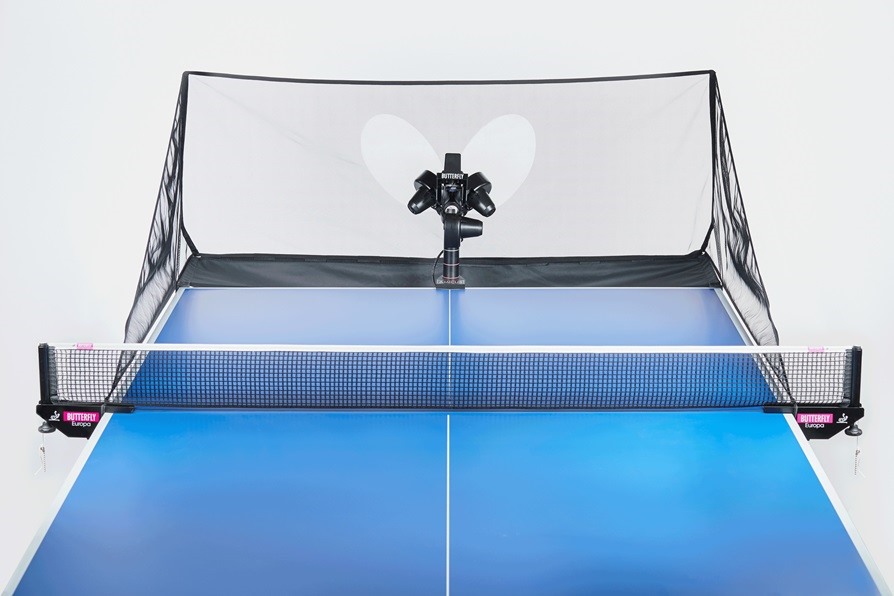
Advantages of Amicus 3-wheel design over 2-wheel designs
(By Larry Thoman)
- 3 wheels can produce any type of spin without rotating the head. This means there is less stress to the head parts because there are no quick start and stop actions to change spins like there would be with only 2 wheels. Less stress means parts will last longer.
- A small light Deflector Plate determines left/right and up/down throwing directions. This part can move very quickly exactly because it is small and light. 2-wheel robots move the entire head left/right and up/down (as well as rotating up to 180°, see #1), and that is a lot of weight and mass to move, which introduces more stress to make these movements.
- Combined, 1 & 2 mean that there are fewer moving parts and the parts that do move are small and light so the Amicus design is more durable and the movements can be accomplished in a shorter amount of time. This is critically important when you have two very different consecutive shots, such as a slow, heavy backspin/sidespin serve followed by a fast heavy topspin loop and you only have a few milliseconds to accomplish all those actions.
- The 3 wheels hold each ball in a much more secure position as it is being thrown. 2-wheel robots can allow the ball to slip sideways a little, resulting in less consistent throws.
2 heads of 2 wheels each:
I fail to see any advantage of this type of design. Everything that this type of robot can do can also be accomplished by the Amicus design. The big disadvantage of a 2-head design, IMO, is that it is very disconcerting to have to concentrate on two different projection points, something that would never happen in an actual game. This is especially true for any type of random delivery. In addition, landing points on the table can get confusing as balls can be thrown to different landing points even though the landing point is supposed to be the same. E.g, Head A throws a ball to landing point 1, but when head B throws a ball to landing point 1, it is 6-8 inches away from where head A threw the ball. Also balls will be thrown from slightly different angles making it more difficult to get your feet properly positioned. I found the experience of playing a 2-headed robot quite unnerving, especially when balls were being projected from both heads at a rapid rate.
I believe the 2-headed design came into existence as one way to resolve the problems pointed out in the first discussion of the advantages of the Amicus 3-wheel design. One way to get a robot to throw consecutive balls that are quite different from one another, but at a fast enough frequency to replicate actual play, would be to use 2 heads. However, as the Amicus shows, if properly designed, a robot can indeed throw 2 very different types of shots with very low intervals of times between those shots (less than half a second). The inherent problems of 2 heads greatly outweigh any advantages, IMO, especially the problem of having to concentrate on two different projection points.


 /* Constant Contact Universal Code */