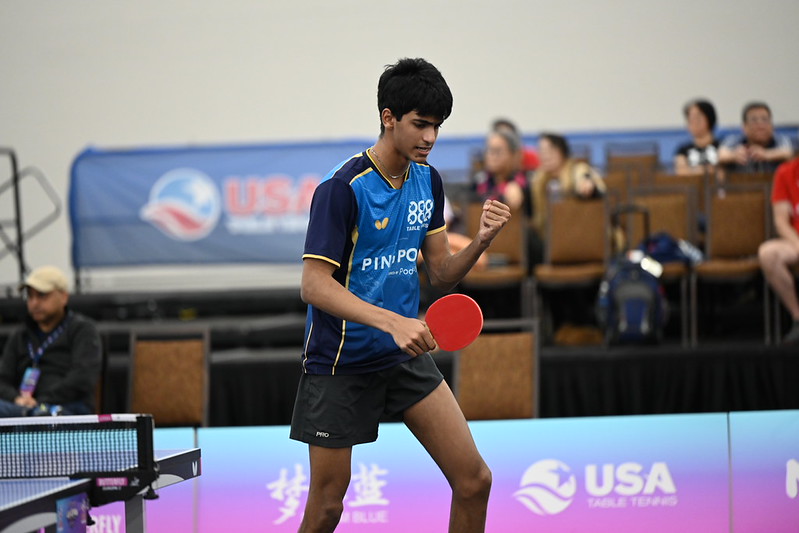
Regardless of whether you watch soccer, this year’s FIFA World Cup produced the kind of storylines that spill over into every other sport. Underneath the goals and the trophies, there were mental lessons about how athletes handle pressure, mistakes, and each other. I’m going to share three of them and analyze how table tennis players can learn from each to sharpen their own mental game.
Cabo Verde: Belief Over Evidence
Cabo Verde is a nation of about half a million people. They were ranked 67th in the world and given roughly a 1 percent chance of even reaching the group stage! In reality, they held world number two Spain to the only scoreless draw at the World Cup, advanced out of a brutal group, and pushed defending champion Argentina to extra time in the round of 32 before finally losing.
The team’s center-back Roberto “Pico” Lopes summed up the team’s mindset simply: The sense that they belonged there, before they’d proven a thing. Sport psychologists distinguish this from confidence built purely on results, but instead believing you can execute the task in front of you regardless of what your ranking or your opponent’s ranking. That belief is decided in advance.
- Application for table tennis: Before you play someone rated well above you, take note of (mentally or literally) one specific thing you do well that will still work against them. Walk to the table having already decided that you belong there. In contrast, paying attention to the rating gap is a losing strategy before you even start competing. For more details on developing self-belief and a champion mindset, check out my previous post Finding Your Champion Mindset: Lessons from Hugo Calderano’s Historic Victory.
Messi’s Missed Penalty: Response Matters More than the Miss
Argentina found themselves down 2–0 to Egypt in the round of 16. Lionel Messi, Argentina’s leading scorer, had just had his penalty saved, which was his second missed penalty of the tournament. Rather than let it compound, Argentina came back with three goals in the final 11 minutes, including one from Messi himself, to win 3–2.
This is a textbook illustration of something sport psychologists call the “next-play mentality.” What separates elite performers after an error isn’t that they don’t feel the miss. It’s how quickly they stop replaying it and redirect attention to the very next opportunity. Dwelling, even for a few extra seconds, tends to bleed into actions in the form of extra tension or hesitation.
- Application for table tennis: After a miss on a serve or on an easy short, give yourself a quick recovery routine, such as wiping your hand on the table, taking 1-2 deep breaths, feeling your feet, and treating that as the hard stop on the previous point to reset for the next. For more details on routines, check out my previous post Use Pre-Point Routines – Mastering Crunch Time Like Timo Boll.
Messi and Yamal: Carrying Both Outcomes
Moments after Spain beat Argentina in the final, 19-year-old Lamine Yamal walked straight over to Lionel Messi to offer a respectful embrace instead of joining his team immediately for celebrations. Messi, devastated but not diminished, told the teenager to “keep going his own way” to greatness. One player had just delivered the best moment of his career. The other had just suffered one of the hardest losses of his. Both managed the minute after the final whistle with the same composure.
This scene points to a useful idea: the moments right after a win or a loss are when instinct, not intention, tends to run the show. Athletes who’ve decided in advance how they want to behave in that window, win or lose, are far more likely to keep their emotions and sportspersonship in check, because they’re not trying to invent good judgment in real time.
- Application for table tennis: Decide right now, away from any match, how you want to act in the minute after both winning and losing a close game. Shake hands, make eye contact, say something respectful. Being a champion is not only about winning the competition but also winning respect.
The Common Thread
These three stories—Cabo Verde’s belief, Messi’s recovery from a miss, and the Messi-Yamal handshake—all point to the same underlying idea: the players who handle pressure and adversity well are the ones who’ve already decided, ahead of time, exactly what they’re going to do with them. It’s a set of small, specific habits any table tennis player can start building in competition as well as practice.



 Stay “In The Loop” with Butterfly professional table tennis equipment, table tennis news, table tennis technology, tournament results, and the next article featuring more equipment insights and professional recommendations. We Are Butterfly players, coaches, clubs and more.