

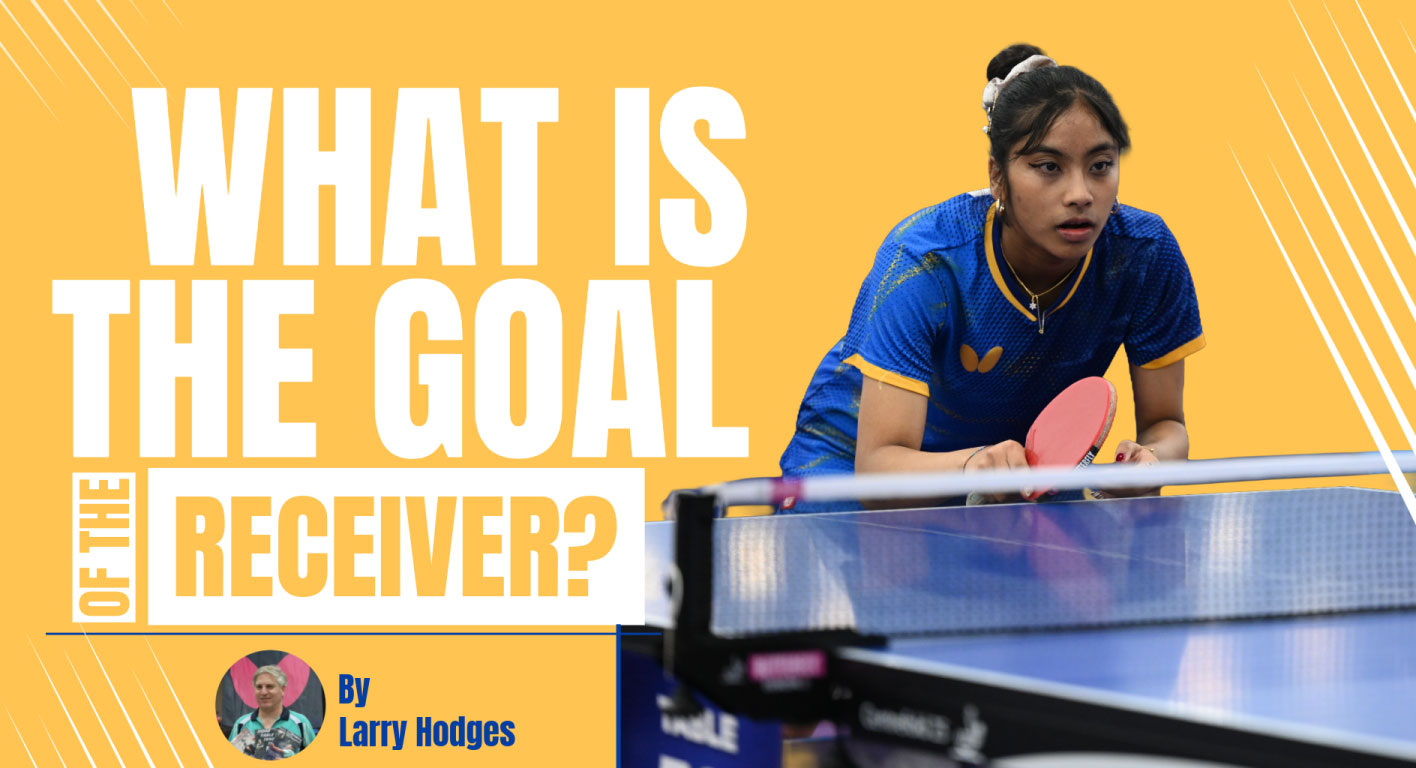
(By Larry Hodges, Member of US Table Tennis Hall of Fame
Returning serve is the most difficult part of the game to master. There are more variations to prepare for than at just about any other time–reading spin off a fast motion, topspin or backspin, sidespin either way, corkscrewspin, no-spin, long or short, fast or slow, to wide angles or the middle–there are infinite possibilities. And yet, most players don’t practice their receive much, except in games, and there they are looking to win, not try something new that might cost them a match. Instead, find someone with decent serves and practice returning them. (And do the same for him.)
But you also need to know what to do with the serve. There are two possibilities.
1) Aggressive receive that takes the initiative. Here the receiver should play aggressive, take the initiative (or even go for a winner), and try to dominate the point. Examples include a short serve that pops up slightly, a serve that goes long that the receiver is ready for (and should usually loop), and serves where the receiver reads the serve well early on and is comfortable attacking. A player should always be looking for such serves and be ready to pounce on them.
The goal isn’t to win the point on one shot; the goal is to take the initiative and put the receiver in an uncomfortable position. Key to this is placing the shot, either to a wide angle or to the opponent’s middle (opponent’s transition point between forehand and backhand, usually the elbow). When flipping very aggressively, you might consider mostly flipping crosscourt at a wide angle, as this gives you more table to aim for.
The down side to an aggressive receive is that you will also lose some points from missing. It’s a tradeoff.
Some players are afraid to attack serves, and return almost all serves passively. This makes things easy for the server, since he can serve knowing that he’s going to get a ball he can attack. You need at least the threat of an attack to make a controlled receive more effective.
2) Controlled receive that neutralizes the serve. The goal is to force the opponent into a mistake or a weak attack, or to catch them so off guard they can’t attack at all. These receives are the most misunderstood. Against a short serve, don’t just push the serve back mindlessly–do something with the return to put pressure on the server. Push quick off the bounce, deep, at a wide angle, low, and with good backspin. Change directions at the last second. Drop it short. Push with sidespin. Push with no-spin, but with a vigorous wrist motion just after contact to fake backspin. Do a steady, well-placed flip. (You should flip most short serves that don’t have backspin.) Constantly vary your receive so your opponent never knows what you’re going to do next.
Against a long serve, mostly loop, but go for consistency, spin, placement, and depth.
Some players feel they have to attack every serve. They aren’t confident that they can handle the opponent’s first attack if they use a controlled receive, even if the opponent’s attack isn’t very strong. The problem here isn’t the receive—it’s the defense. If you can’t block an opponent’s loop (or consistently handle it in some other way that fits your game), then you need to work on your defense.
Which of the two receives should you use? You should generally favor controlled receives until you have mastered that, and are comfortable against the opponent’s attack off that receive. When you can do that, you’ll have enough control to be more aggressive off the serve, and then you should do either, depending on your opponent and your playing style.
Stay “In The Loop” with Butterfly professional table tennis equipment, table tennis news, table tennis technology, tournament results, and We Are Butterfly players, coaches, clubs and more


 /* Constant Contact Universal Code */