

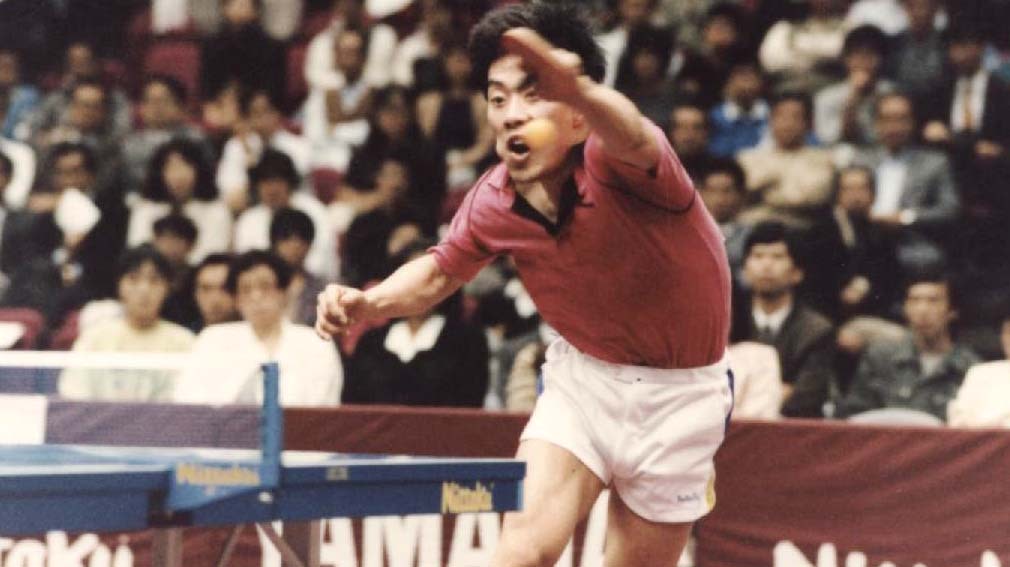
(by Steve Hopkins, photo Butterfly)
Table tennis made its Olympic debut in Seoul back in 1988, and it’s worth pausing on that anniversary for a moment. Today (September 23), is exactly 38 years since action kicked off at “our” first Olympics – the inaugural games for our sport. And in two years we will be celebrating the 40th anniversary of Olympic table tennis with six events in Los Angeles.
Looking Back:
Over 65,000 tickets were sold for those first events at the Seoul National University Gymnasium, and 129 athletes from 41 countries took part across four events – Men’s and Women’s Singles and Men’s and Women’s Doubles. Yoo Nam-Kyu of Korea became the first-ever Olympic Men’s Singles champion, beating countryman Kim Ki-Taik in an all-Korean final, while Sweden’s Erik Lindh took bronze. On the women’s side, China’s Chen Jing won gold, with teammates Li Hui-Fen and Jiao Zhi-Min rounding out a Chinese sweep of the podium. An all Chinese sweep was a fitting preview of much of the future of women’s table tennis.
Since that first Games, China’s dominance of Olympic table tennis has been about as complete as dominance gets in any sport. China has won 32 of the 37 gold medals awarded since 1988. In Women’s Singles, it’s even more lopsided – China has claimed every single Women’s Singles Gold Medal in Olympic history, nine out of nine. Deng Yaping and Zhang Yining each won the event twice.
But the Men’s Singles picture tells a slightly different story. China has won six of the nine Men’s Singles titles since 1988, so a third of the time the Gold Medal has been outside of Beijing’s grasp. Yoo Nam-Kyu got the whole thing started in 1988. Four years later in Barcelona, the incomparable Jan-Ove Waldner beat France’s Jean-Philippe Gatien for Sweden’s only Olympic table tennis gold. And in Athens in 2004, Ryu Seung-Min played spoiler for the Korea Republic, outlasting China’s Wang Hao in six games to deny China a clean sweep of that Games. Only Ma Long has ever won the men’s title more than once, taking back-to-back golds in 2016 and 2020 before Fan Zhendong picked up the torch in Paris last summer. It’s proof that even at its most dominant, China has never had a total lock on the men’s side of the sport.
Looking Ahead:
That history matters more right now than it has in a while, because the parity we’re seeing today on tour is real. Fan Zhendong needed five games to get past Sweden’s Truls Möregårdh in the Paris final, and Möregårdh had already knocked off World No. 1 Wang Chuqin on his way there. Players like Möregårdh, the Lebrun brothers, Harimoto, Ovtcharov, and Calderano have all put together stretches where they’ve beaten the best China has to offer. Still, China sets the standard the rest of the sport measures itself against – and if you had to be China versus the world, the betting markets might still favor China. But the gap has been closing, and the results on the WTT tour back that up.
None of that is an accident. The ITTF has invested heavily in to the WTT and its tour events. And there are many more professional opportunities than there were just a decade ago – including the MLTT professional league in the United States. The game has globalized in ways it hadn’t in 1988, when Olympic table tennis was still finding its footing on the world stage. More countries have real investment in the sport, more players are training and competing, there is more parity and more diversity at the top of the world rankings than there was in recent past decades. And that parity gives our sport a potential that just wasn’t there 30 years ago.
The 40th Anniversary Possibilities:
That sets up an interesting few years ahead of us. We’re closing in fast on another Olympics on American soil. Olympic table tennis has been to the U.S. once before, back in Atlanta in 1996. At that Games, China swept both singles titles and grabbed eight of the twelve available medals – basically winning at every level they could. A lot may change in Los Angeles. We may see the emergence of a new Chinese set of stars, and the dominance may begin again. Or we may see the continued rise of non-Chinese players and more parity (at least on the Men’s side). Regardless, Americans will have their second chance to see Olympic table tennis on home soil. And its likely that they’ll do so while cheering for some highly ranked American players – as our young players look as though they may peak at the right time, and we already have players in the top 30 in the World in both Men’s and Women’s singles. Competition is set to run at the LA Convention Center’s Hall 3, and the program will be the biggest in the sport’s Olympic history – 6 events: Men’s and Women’s Singles and Doubles, Mixed Doubles, and for the first time ever, a Mixed Team event. Forty years after Seoul introduced the world to Olympic table tennis, the sport returns to the United States with more depth, more parity, and more storylines than it’s ever had. It should be worth the wait.
Visit ButterflyOnline.com for the latest table tennis news and results.


 /* Constant Contact Universal Code */