

Why is Boll Strong?
(Video and English Subtitles Courtesy of BUTTERFLY/TAKUREPO.com)
Special Program
Q: Why is Boll strong?
A: Services difficult to receive short
Sidespin short service
Timo Boll (GER) ascended to the World no. 1 spot in March 2018. Young players have distinguished themselves one after another recently. Table tennis has continuously experienced various rule changes but despite all the changes why does his strength not fade away in this age of intense rivalry, even at the age of 37? It is more than just thinking that “He is special.”
Moreover, it must help many players improve their level if they understand the techniques and strategies that have helped Timo Boll stay at the top level for such a long time.
We will unravel his strengths with the help of his former teammate Seiya Kishikawa (JPN) with whom Timo Boll both practiced and faced in matches many times in the past. Also we asked Timo Boll for self-analysis.
Witness by Seiya Kishikawa
”Boll’s service carries a great deal of spin; short receive is tough.”
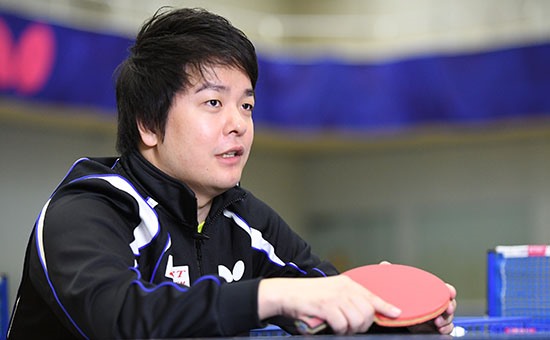
Boll is a player who has no weakness in technique. Such a player without any weakness will not lose his capability easily even at a more senior age.
We are most likely to focus the heavy topspin rotation he imparts on the ball with his forehand but he is first of all proficient with service; his service is mainly with sidespin, sideways movement both ways. It is not very difficult to read the spin; the uniqueness is the heavy spin. Therefore, it is difficult for the opponent to receive short; the receive will often go too long over the end of the table, enabling him to attack the ball with heavy topspin.
We can also receive his sidespin service with a flick but a flick receive is not effective enough because he is also brilliant at counter topspin.
Self-analysis by Timo Boll
”I use small centimeters (in service).”

”I think my service is very good because I have a lot of variation. It’s not just the spin. It is also the placement and the variation of different lengths, different spins, so the opponent cannot adapt quickly. The result is he is not precise anymore and then I can use the small centimeters. So this is my strategy and also one of my biggest strengths.”
Boll’s side-spin short service
Point 1: Make the first bounce close to the end of the table

Even when making a short service, make the first bounce close to the line
Boll’s service, controlling the length in a few centimeters, is an important conducting wire for his attacking strokes on both wings. Boll uses sidespin service with both right and left sidespin changes. Let us introduce his sidespin short service first (with sidespin top left for left handers; to the right for right handers).
“I’m focusing to put the first contact very much at the front of the table so that it’s coming somewhere here (close to the net) and that it has the chance to bounce second time on the table, so that is short. This is the most important thing in the beginning,” Boll explained.
When making a short service, in general, players try to make the first bounce close to the net. However, Boll says he tries to place the first contact close to the end-line for the short service, just the same as the long service. This technique is the main reason why his service is effective; not making the opponent able to read the length of his service.
Point 2: Compact swing to prioritise control and quick recovery

Swing bending the upper body to put muscle easily on impact
Let us look at his swing next. Boll’s motion is very small from the backswing to the follow-through (the movement of his racket after impact). This simple and compact swing enables him to gain precise control to adapt to a quick return and preparation for the third ball.
Please use his motion as a guide; he makes a swing lowering his head. It is easy to impart spin on the ball even with a small swing if you make the full use of the momentum created by lowering the head and leaning forward. It becomes easier to put strength at impact (the moment of hitting the ball).
In addition, some other benefits will be derived from making the head and the impact closer by leaning forward; it is easy to find the right timing and control will be better.
For original article, please click here


 /* Constant Contact Universal Code */