(by: Bowmar Sports Team)
Question: It’s pretty widely accepted that when serving underspin, more spin is produced by contact with the lower portion of the racket than with the upper portion. Can you explain the rotational differences that occur between these two contact locations? What is making the difference?
Answer: The reason we get different amounts of spin on serves based on contact location on the paddle is based on two facts:
- The faster the paddle’s surface brushes the ball, the more spin you get
- During the underspin service motion, the part of the paddle that’s moving the fastest is the part farthest from your wrist.
#1 should be pretty clear. The faster you’re brushing the ball, the more spin you get. You can test this out with slow vs fast motions, but just be careful to be brushing the ball equally (rather than hitting into it).
#2 is more interesting.
Most underspin service involves rotating the paddle about your wrist (sometimes described as “snapping your wrist during contact”). When the paddle undergoes rotational motion about an axis (located at your wrist), the parts of the paddle furthest from that axis will be moving the fastest.
If this seems tricky, imagine holding a broom by the end of the handle, and swinging it around your head. In that case, the “axis of rotation” would be by the end of the broom handle where you’re holding it. As it swings around, that part really doesn’t travel very far, so it has a low velocity.
The other end of the broom, however, has to travel very far to get all the way around the circular arc, and since it does that in the same amount of time, it must be traveling much faster than the part of the broom handle you’re holding.
The same thing happens with the paddle rotating about your wrist. The part of the paddle furthest from your wrist will be moving the fastest, and so will impart the most spin to the ball if you contact it there. The part nearest your wrist will be moving the slowest, and so will impart the least spin. All the parts in between will be moving at some “in between” speed, so they’ll give you an “in between” spin.
The same thing happens in all the shots in table tennis, actually, but it’s most noticeable with serves, pushes, and backhand banana openings.
The reason it’s most noticeable with those shots is because the difference in speed (from rotation) between two points on the paddle depends on the ratio of the distance between those points and the axis of rotation.
For serves (or other shots that use a lot of wrist motion), the furthest part of the paddle might be 2x further from your wrist than the nearest part of the paddle. That means 2x the speed, so 2x the spin!
On the other hand, imagine someone playing a big, brushing forehand loop mostly using rotation about their shoulder. With a shot like that, the near part of the paddle might be 65cm from their shoulder (the axis of rotation), while the far part of the paddle might be 75cm from their shoulder. That’s only 1.15x further, so you’ll only get a 1.15x difference in speed between the two points, so only 1.15x the spin.
Now we’re almost done. We’ve covered the question of contact position near the handle or near the tip of the paddle. But a lot of people also talk about contact position left and right of the tip. What about that?
This part is easiest with a diagram, and it’ll be all about distance again.
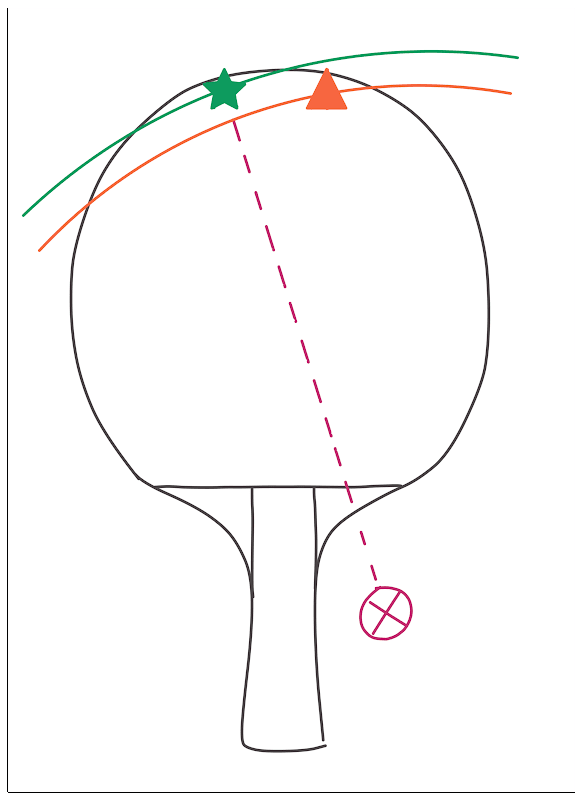
Here we’ve drawn the location of the wrist (with an ‘X’) for a right handed player, assuming we’re looking at the forehand side of the paddle. Notice that it’s a little off to the side of the handle?
We’ve drawn the wrist location because it’s the axis of rotation for serves. And the fact that it’s off center means that the part of the paddle just to the left of the tip (green star) is actually a little further away than the part of the paddle just to the right of the tip (orange triangle). A contact point further away from the axis of rotation means more speed at contact, which means more spin.
Of course, there are other factors that go into the final result, but it’s the distance to the axis of rotation that contributes the most to the difference in spin on serves based on contact location on the paddle.
Best,
Stefan Feth
Olympic Coach & USATT National Coach
Coach @ WCTTA
www.tt-champions.com
Stay “In The Loop” with Butterfly professional table tennis equipment, table tennis news, Table Tennis technology, tournament results, and We Are Butterfly players, coaches, clubs and more.